
Buying a car at auction in Lithuania starts with a total-cost question, not the number on the listing. A low starting bid can be outweighed by missing documents, recovery transport, structural repairs, registration tax or an ownership-declaration problem.
The safest approach is to treat the car as three separate subjects:
- a legal asset you must be able to acquire and register;
- a machine whose present condition needs evidence;
- a project with a total cost, not just a winning bid.
The checklist below applies to local bailiff and other Lithuanian vehicle auctions. The official notice and organiser's rules control the individual sale.
1. Identify the auction type and seller
Start with the source notice, not an aggregator headline. Confirm whether the vehicle is offered through:
- a bailiff's judicial auction;
- an insolvency sale;
- a public-body auction;
- an insurer, leasing company or fleet sale;
- a private auction platform.
This determines the registration payment, refund rules, settlement deadline, transfer document, taxes and whether a seller must confirm an ordinary ownership declaration.
For a bailiff judicial auction, the 10% bidder's fee is credited toward the winning price. Do not add it again as a buyer's premium. Other organisers may charge a service fee or deposit under their own rules.
2. Confirm the exact vehicle
Match these details across the notice and every attachment:
- VIN;
- make, model and variant;
- first registration or model year;
- engine, fuel and transmission;
- registration number, if shown;
- odometer reading and the date it was recorded;
- location and collection contact;
- keys, registration certificate and other documents included;
- whether the car is complete, dismantled or sold for parts.
If the VIN is missing or inconsistent, ask the organiser before registering. Do not bid on a vehicle identified only by photographs.
3. Inspect the VIN on the vehicle
When access is permitted, locate the VIN on the body and compare it with the notice and documents. Look for damage, re-stamping, unusual welds or corrosion around the marking.
A VIN copied correctly into an advert does not prove that the car in the yard is the same legal identity. If the marking cannot be verified, treat registration as unresolved.
4. Verify the SDK
Lithuania uses an owner declaration code known as the SDK (savininko deklaravimo kodas). Regitra says vehicles covered by the Lithuanian ownership-accounting system need this code for sale, ownership declaration and registration.
Before bidding:
- obtain the SDK shown for the vehicle, if applicable;
- use Regitra's official verification route;
- confirm that the returned make/model/VIN data match;
- ask the organiser which transfer document will be issued;
- ask Regitra how that auction deed will be used for the acquisition declaration.
Regitra lists a deed transferring an asset sold at public auction as a document capable of proving ownership. That does not remove the need to follow the correct declaration and registration steps for the exact sale.
5. Check restrictions and registration status
Use Regitra's official tools to check available information about restrictions, registration and the vehicle's ability to enter the ownership process.
Ask in writing:
- which seizure or restriction led to the sale;
- which restriction is expected to be removed and by whom;
- whether the vehicle is currently registered, deregistered or exported;
- whether plates and the registration certificate exist;
- whether any identity inspection is expected;
- whether the vehicle can be registered in Lithuania or is sold only as a non-road asset.
Do not assume that winning the auction makes every register warning disappear instantly.
6. Build a document and key inventory
Create a literal list of what will be handed over:
- auction sale deed or contract;
- registration certificate;
- certificate of conformity or other technical documents, where relevant;
- number plates;
- one or more keys;
- service records;
- roadworthiness evidence;
- import/customs evidence for a previously imported vehicle;
- accessories or removable equipment shown in the listing.
Missing keys can mean towing and immobiliser programming. Missing registration or technical documents can create delay, extra inspection or a registration blocker.
7. Use vehicle-history reports as leads, not proof
A commercial VIN report can reveal recorded accidents, auctions, mileage events or foreign registration. Search the VIN directly as well; historic auction photographs sometimes remain indexed.
But a clean report does not prove:
- the vehicle has never been damaged;
- the current mileage is correct;
- repairs were structurally sound;
- airbags and safety systems are present;
- the engine, battery or gearbox is healthy;
- the vehicle can be registered.
Combine history with official data, documents and physical inspection.
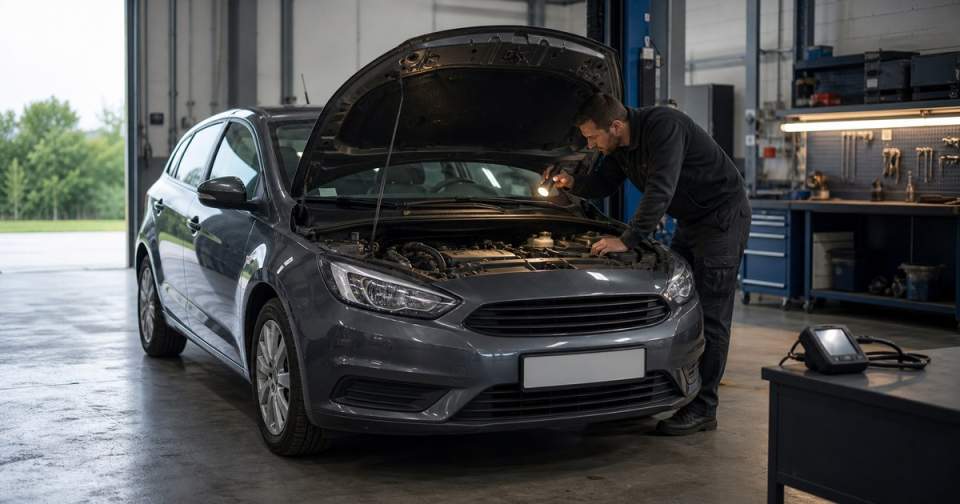
8. Inspect the car's present condition
If an inspection is allowed, use a technician who understands accident repair and the model's known failure points.
Check at minimum:
- cold start, warning lights and diagnostic codes;
- engine, transmission and cooling system;
- high-voltage battery and charging on an EV or plug-in hybrid;
- brake, steering and suspension components;
- tyres and wheels;
- fluid leaks;
- chassis rails, pillars, sills and crumple zones;
- panel gaps, welds and paint thickness;
- airbags, seatbelts and restraint-system faults;
- water ingress and flood evidence;
- odometer consistency with wear and records.
If the car cannot be started, lifted or scanned, price it as an unknown mechanical project—not as a running vehicle with one visible defect.
9. Do not overvalue a roadworthiness certificate
A valid technical inspection means the vehicle met the tested requirements at the time of that inspection. It does not guarantee current condition or the remaining life of expensive components.
Confirm the inspection date and any available history. Then make a present-day safety assessment. A car can deteriorate, be damaged or have parts changed after an inspection.
10. Plan collection before bidding
Ask the organiser:
- when and where the vehicle can be collected;
- whether an appointment is required;
- whether the wheels roll and steering works;
- whether keys are available;
- whether a recovery truck can access the site;
- who loads a non-running vehicle;
- whether storage charges begin after a deadline.
Plan to use a trailer or recovery truck unless registration, insurance, roadworthiness and present mechanical condition all support lawful, safe road use.
11. Check registration, tax and immediate compliance costs
Depending on the vehicle and intended use, the budget may need to include:
- recovery transport;
- diagnosis;
- urgent safety repairs;
- registration tax for applicable M1/N1 vehicles;
- ownership declaration and registration services;
- plates;
- roadworthiness inspection;
- identity or conformity procedures;
- compulsory insurance;
- customs or VAT issues for certain imported vehicles;
- translation of documents;
- storage.
Use current Regitra data for the registration-tax calculation. Do not estimate it from engine size alone.
12. Calculate the true cost and bid ceiling
Use two lines:
Total acquisition cost = winning bid + collection + diagnosis + repairs + registration/tax + inspection + insurance + missing-document/key costs + contingency.
Maximum bid = conservative value of a comparable roadworthy car − every additional cost − uncertainty reserve.
Compare like with like: model, engine, year, mileage, equipment, condition, registration status and accident history. Dealer asking prices are not completed-sale prices.
For resale, add cleaning, storage, finance, selling costs, warranty exposure and your labour. For personal use, include the next scheduled service, tyres, brakes and known model-specific preventive work.
Practical stop/go table
| Check | Action | Stop or reduce the bid when… |
|---|---|---|
| VIN | Match notice, documents and body | It is missing, altered or inconsistent |
| SDK | Verify through Regitra | The code or returned data does not match |
| Restrictions | Check official status and organiser's route | Removal/registration is unexplained |
| Documents | List every item to be transferred | The ownership or registration basis is incomplete |
| Condition | Inspect and diagnose | The car cannot be assessed and the contingency is inadequate |
| Collection | Obtain a recovery plan and quote | Access/loading is unknown |
| Total cost | Complete the formula | The next bid erases the risk-adjusted saving |
Browse current vehicle and asset auctions in Lithuania, then open the official source notice before registering.
This article is general information, not legal, tax, registration or mechanical advice.
Sources
- European e-Justice: Judicial auctions in Lithuania
- Regitra: declaration of vehicle owners and SDK
- Regitra: search for an SDK
- Regitra: vehicle purchase checks and contract guidance
- Regitra: vehicle restrictions check
- Regitra: registration tax
- Transeksta: roadworthiness e-services
Frequently asked questions
Is the 10% bidder's fee added to the winning price?
Not in a bailiff judicial auction. It is credited toward the purchase price. Other organisers may use different fees.
Is a valid roadworthiness inspection proof of good condition?
No. It is point-in-time compliance evidence, not a substitute for a current inspection.
What is an SDK?
It is Lithuania's vehicle owner declaration code. Verify it through Regitra and confirm the auction-deed route before bidding.
Can I drive an auction car away immediately?
Only if the documents, registration, insurance, roadworthiness and actual condition all allow lawful and safe road use. Otherwise use recovery transport.