
An apartment's starting price can look compelling. The difficult part is establishing what the price does—and does not—include.
At a Lithuanian auction you may be buying the whole apartment, a fractional share, premises registered for another use, or an occupied property that cannot be handed over immediately. Photographs rarely answer the legal, building and possession questions that drive the real cost.
Use the 12 checks below before you register. They are designed for Lithuanian bailiff and public auctions, but the official notice for the individual sale always controls.
1. Confirm the sale type and exact asset
Open the source notice on the official e-auction portal. Record the organiser, sale type, unique property number, address, registered use, floor area and share.
Do not read “apartment at [address]” as proof that 100% ownership of a self-contained home is being sold. Check whether the lot is:
- the entire registered apartment;
- a fraction such as 1/2 or 1/8;
- one room or set of premises;
- an apartment with separately registered appurtenances;
- a lease or another right rather than ownership.
Stop if the identifiers in the headline, notice and attachments do not agree.
2. Obtain current Real Property Register information
The Lithuanian Real Property Register is the starting point for title and registered-right checks. Obtain a current extract through the Centre of Registers or have a Lithuanian professional obtain and explain it.
Match the extract to the auction notice. Review:
- owner and ownership share;
- registered use and physical data;
- mortgages, seizures and other legal facts;
- easements, use rights and leases where recorded;
- restrictions or notes affecting transfer or use;
- appurtenances and related units.
Do not rely on an old extract attached months earlier if updated evidence is available.
3. Compare the cadastral plan with reality
The registered floor plan and area should match the premises offered. Compare room arrangement, walls, balconies, storage areas and entrances with the photographs and any inspection.
Warning signs include:
- a kitchen or bathroom moved without matching cadastral data;
- a balcony enclosed or room added without clear documentation;
- two units physically combined but still legally separate;
- a basement, loft or parking place mentioned in advertising but absent from the register;
- material disagreement between listed and measured area.
Unregistered alterations can affect valuation, insurance, lending and future renovation. Do not assume they can be legalised cheaply—or at all.
4. Establish who occupies the apartment
Ownership and possession are different questions. Ask the organiser in writing whether the apartment is vacant, occupied by the debtor, used by family members, or subject to a lease or another use right.
If it is occupied, ask:
- what evidence of the occupancy is available;
- whether a lease or use right is registered or disclosed;
- whether keys and voluntary handover are expected;
- what process the buyer would need if the occupants do not leave;
- whether vulnerable residents or minors are mentioned in the file.
Do not budget for immediate move-in or rent until the possession route is credible. Never plan self-help eviction, lock changes while the property remains occupied, or removal of belongings without lawful authority.
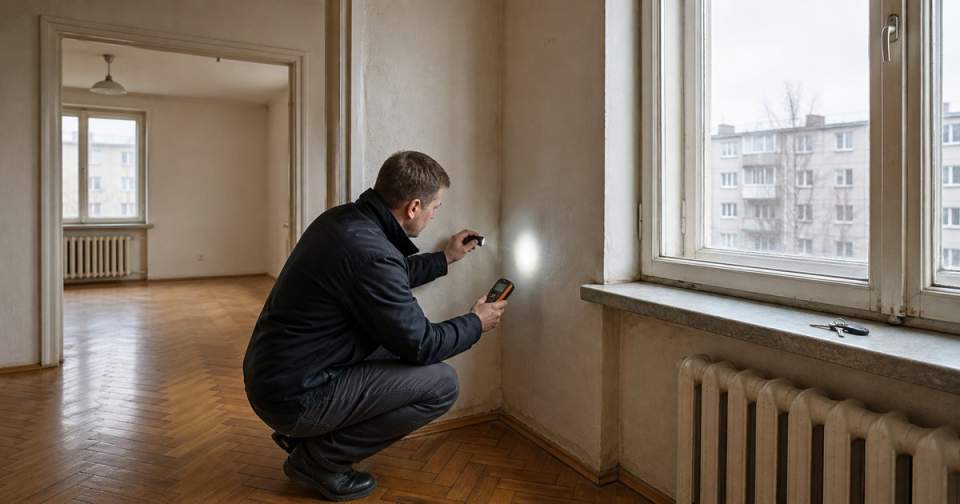
5. Inspect the apartment—or price the absence of access
Use the viewing details in the notice. If an inspection is possible, bring a construction professional when the potential repair bill is material.
Check:
- signs of moisture, mould and leaks;
- windows, doors and locks;
- electrical panel and visible wiring;
- water, drainage and heating connections;
- floors, walls and ceilings;
- ventilation;
- fire or flood damage;
- whether services are connected;
- items that will actually remain.
If the organiser cannot provide access, photographs are not a substitute. Apply a larger contingency and decide which unknowns would make the property unfinanceable or uneconomic.
6. Verify storage, parking and other appurtenances
A cellar, parking space, attic area or storage room shown to you may be:
- part of the apartment;
- a separate registered unit;
- common property used by informal arrangement;
- owned by someone else;
- not included in the auction lot.
Require the notice, register and plan to tell the same story. Value only the rights being sold.
7. Review the building, not just the apartment
Contact the building administrator or owners' association where possible. Ask for evidence about:
- the building's management arrangement;
- recent meeting decisions;
- approved or proposed major works;
- roof, façade, lifts, pipes, heating system and common electrical installations;
- emergency repairs or litigation affecting the building;
- insurance of common property;
- the apartment's share of common costs.
A renovated kitchen does not offset a failing roof or an approved six-figure building project.
8. Separate personal debts from property-related obligations
Do not accept either simplistic claim: “all old debts transfer” or “nothing can follow the property”. The former owner's personal loan, tax or utility liability does not automatically become yours. But registered rights, owners' decisions, renovation financing and certain property-accounted amounts may affect the apartment or future owner.
Ask the administrator or association for a dated statement and copies of relevant decisions. For any substantial or disputed amount, ask a Lithuanian lawyer or notary to explain who owes it after this specific sale.
9. Check energy performance and real running costs
An energy performance certificate is useful, but it is not a forecast of your exact bills. Ask for the certificate and, if available lawfully, representative heating or utility data.
Consider:
- floor and position in the building;
- external walls and windows;
- roof or basement exposure;
- heating type and metering;
- planned energy renovation;
- vacant-property reconnection costs.
Use a conservative monthly budget if the apartment has been empty or the data is incomplete.
10. Test the financing route against the exact property
A general mortgage pre-approval is not property approval. Give the lender the official notice, register data, sale type, inspection evidence, occupancy position and payment deadline.
Ask in writing:
- whether this auction procedure is financeable;
- whether the registered use qualifies for the intended mortgage;
- whether a fractional share or occupied property is acceptable collateral;
- which valuer and documents are required;
- how long approval and disbursement realistically take;
- how a valuation below the winning bid changes your own-funds requirement.
In a bailiff judicial auction, the payment deadline is not extended because you use a loan.
11. Calculate the total acquisition cost
Start with the possible final bid, then add property-specific costs:
- legal and register review;
- valuation and lender charges;
- registration and insurance;
- immediate safety work;
- full repair budget;
- lock and security work after lawful possession;
- building or renovation obligations confirmed for the property;
- possession and clearance costs;
- utilities and reconnection;
- time during which the apartment cannot be used or rented;
- contingency for unknowns.
In a bailiff auction, the 10% bidder's fee is credited toward the final price. Do not add it twice.
12. Set a written bid ceiling
Use a calculation, not an emotional target:
Maximum bid = conservative value of the apartment in its verified legal and physical condition − all additional costs − possession risk − contingency.
Compare genuinely similar apartments by location, area, floor, condition, registered use and ownership type. Asking prices are not completed-sale prices. Use several sources and the lower defensible scenario.
Do not increase the ceiling because you are one bid away from winning. Winning above your evidence-based value is still overpaying.
Quick stop/go table
| Check | Evidence to obtain | Stop or reduce the ceiling when… |
|---|---|---|
| Asset | Notice and unique number | It is unclear whether the whole apartment is sold |
| Title | Current register extract | A right or restriction is unexplained |
| Layout | Cadastral plan and inspection | Material alterations are undocumented |
| Occupancy | Written organiser information | Vacant possession is assumed, not evidenced |
| Condition | Inspection or professional estimate | Repair cost has no defensible basis |
| Building | Administrator/association records | Major approved work is unquantified |
| Finance | Property-specific lender route | Funds may not arrive before the deadline |
| Price | Written calculation | The next bid exceeds the ceiling |
Browse current Lithuanian real estate auctions, but always complete the checks against the official source notice.
This article is general information, not legal, engineering or lending advice.
Sources
- European e-Justice: Judicial auctions in Lithuania
- Centre of Registers
- Centre of Registers: electronic auction FAQs
- Official e-Auctions and Judicial Auctions portal
- Lithuanian Chamber of Bailiffs: online-auction guidance
Frequently asked questions
Do I take over all of the former owner's debts?
No. Personal debts do not simply become yours. However, registered rights, building decisions, renovation financing and property-specific amounts still require review.
Can I inspect the apartment?
Sometimes. Use the notice and contact the organiser. If access is unavailable, increase the contingency or do not bid.
Can I use a mortgage?
Potentially, if the lender accepts the property, sale procedure and timetable. Obtain a property-specific route before bidding.
What is the most important first check?
Confirm exactly what is being sold. An address does not prove that the lot is the whole apartment.